1949. A British publisher puts a small book on the shelves featuring an unexpected hero, Noddy, and the young English readership discovers a fresh face in children’s literature. Enid Blyton, the creator, fills the shelves with children’s books but keeps many keys about her flagship characters to herself.
Year after year, the genre of Noddy becomes the subject of passionate discussions. There is no clear stance from Enid Blyton or her publisher, and inevitably, the public allows for all interpretations. The gap between what readers perceive and the sometimes presumed intentions of the author is intriguing.
Who is behind Noddy? A portrait of his creator and the genesis of a cult universe
Noddy, originally from England, is one of those figures that transcends generations without aging. His author, Enid Blyton, imagined a tender universe in 1949, populated by colorful friends, in the miniature town of Toyland. The illustrations by Harmsen van der Beek give this setting a familiar and endearing aspect, where Big Ears, Sly, or Gobbo regularly cross paths with the hero.
The French version, brought to life by Jeanne Hives and later published by Hachette, retains the unique tone of the series. Albums, cartoons, toys, or educational games, the Noddy universe expands but never sacrifices its original matrix. This consistency is no coincidence: the hero has always refused to fit into too narrow boxes, multiplying the entry points for each new reader.
At the heart of these multiple adaptations, one question keeps coming back: the gender of the character Noddy. Neither Enid Blyton nor her publishers have ever provided a definitive answer, leaving a fruitful ambiguity hanging. Noddy thus escapes categorization, becoming a mirror for all potential identities. This choice, far from being trivial, questions how children’s literature constructs its heroes and conveys models.
By resisting labeling, Noddy establishes himself as a figure accessible to all, without exclusivity. The debate about his gender, far from being anecdotal, reveals the ability of fiction to question boundaries and to open, from childhood, the imagination to multiple identities.
The gender of Noddy: simple question or true mystery according to the creators?
Neither Enid Blyton nor the teams that succeeded her have ever fixed Noddy’s gender. Since his first appearance, the character has evolved in a carefully maintained indeterminacy: no declaration, no label. This editorial choice, far from being a mere oversight, opens new horizons. Each reader can recognize a part of themselves in Noddy, without facing an imposed boundary.
The adaptations in albums, cartoons, or toys respect this stance. Depending on the translations and the times, pronouns vary: here the masculine, there a neutral form, sometimes even a marked absence of gender. This flexibility becomes a strength, allowing Noddy to traverse cultural contexts and remain relevant.
This philosophy aligns with the recommendations of the High Council for Equality, which promotes more open representations in the children’s universe. Noddy fits into no predefined box, making him a valuable tool for inviting children to question stereotypes and imagine other forms of heroes or heroines.
Here are three aspects that make Noddy a unique character:
- Ambiguous gender identity: it allows everyone to identify, without restriction
- Diversity: it opposes traditional gendered character schemes
- Educational effect: it encourages equality between girls and boys from a young age
By breaking free from codes, Noddy blurs the lines and invites a different perspective on childhood. Whether in books or on screen, he remains elusive, escaping any fixed definition.
Diving into the world of Noddy: anecdotes, evolutions, and well-kept secrets
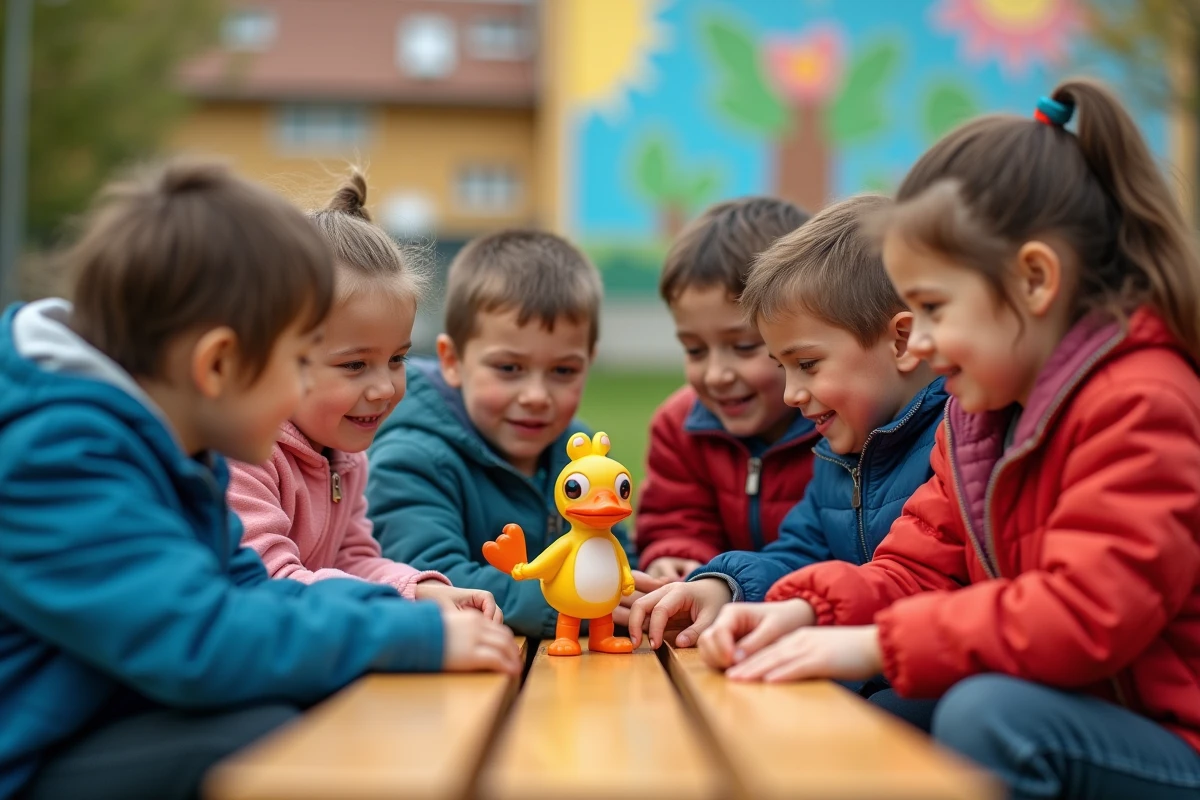
Toyland, the world of Noddy, has continued to enrich itself over the decades. Around him revolves a whole gallery of characters, each adding their nuance: Big Ears, Sly, Gobbo, Bibi the bird, Officer Plod. Over time, new faces appear, such as Luna, Zipp, or Tito the Tam-Tam in the 2023 series, proving that the hero’s universe knows how to renew itself.
Noddy knows no borders: carried by different names in various countries, Zvonko, Nicke, Lelumaan Niksu, he adapts to cultures while retaining his DNA. Far from stopping at books, the adventure continues on television, in toy aisles, or at school through educational materials. Each new version feeds the reflection on representation and inclusion, without ever freezing the character’s identity.
Since 1949, Noddy has evolved without ever losing his ability to bring people together. Children and adults share the curiosity of discovering the slightest transformation of this eternal jingly hat. Noddy is the living laboratory of friendship, diversity, and respect for differences. A hero who, indeed, resembles no other.