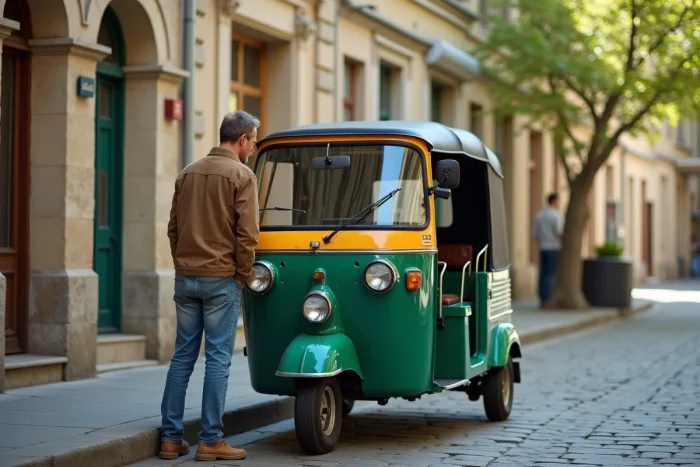
Anyone who thinks they can drive across France in a tuk-tuk freshly arrived from Bangkok faces a reality that is far less exotic: here, without European approval, it is impossible to take the tricycle out of the garage. Imported models without compliance often remain stuck at the port, condemned to dust due to lack of proper paperwork.
As soon as the idea takes root, it runs into French regulations: skipping steps is impossible. A new tuk-tuk, compliant with all local standards, rarely costs less than 14,000 euros. The price quickly rises: whether electric or not, specific finishes, signature of a recognized brand… each criterion increases the cost. In the used market, it remains discreet, dotted with atypical vehicles or patient individuals. Finding a reliable example for less than 7,000 euros is quite a feat, given the sharp demand and the rarity of vehicles in impeccable condition. On the other hand, electric models are increasingly appealing, supported by some local subsidies. The challenge remains to tackle an administrative file as dense as an urban traffic jam.
Price Overview of New and Used Tuk-Tuks in France
In the French market, the price of a tuk-tuk in France varies widely. The acquisition of a new vehicle generally ranges between 13,000 and 18,000 euros depending on the configuration and equipment required for approval. This step is never just a formality: additional lights, mandatory seat belts and safety features systematically increase the bill. Without complete compliance, there is no hope of obtaining an official registration card.
On the used side, only the most persistent connoisseurs manage to get their hands on a Piaggio Ape Calessino or another tuk-tuk worthy of the name, with impeccable paperwork. In practice, these well-preserved models often trade between 6,500 and 12,000 euros, depending on their history and maintenance. A few modified or restored gems are listed at amounts that sometimes double the average.
To clarify the picture, several trends emerge in the listings:
- The new electric tuk-tuk regularly occupies the 15,000 euro range. Some large cities are timidly starting financial aid, but under strict conditions.
- For gasoline or diesel versions, each purchase hides its pitfalls: unclear history, unpredictable repair costs, or examples that are worn out.
For those who want to know refined price ranges, user reviews, or concrete feedback, the page price of a tuk-tuk in France details budgets, examples of recent transactions, and practical, on-the-ground advice.
What Criteria Influence the Cost of a Tuk-Tuk and How to Compare Effectively?
The price range of a tuk-tuk is explained by numerous parameters. The first: the engine type. Electric models are now appealing for their quiet operation, clean image, and the promise of easier urban use. However, it requires the installation of a charging station at home and careful consideration of actual range. Gasoline and diesel models, on the other hand, require increased monitoring of maintenance costs, especially since few garages are familiar with this type of atypical vehicle.
Before diving in, it is useful to check a few crucial points:
- The gearbox: an automatic promises comfort but inflates the bill at purchase and repair.
- The maintenance log: the only serious proof of the vehicle’s upkeep.
- Approval and registration card: without these two, the idea of driving comes to a halt.
Underlying this is the question of new versus used. New, the manufacturer’s warranty secures the investment. Used, thorough investigation is necessary: check every document, trace every receipt, and test the vehicle without haste. Meeting multiple sellers can help avoid many pitfalls.
Approval, Ecology, and Legislation: The Traps to Avoid Before Buying
Acquiring a tuk-tuk in France means diving into the perfect balance between administrative rigor and local adaptation. No approval? The vehicle remains stuck in the garage. Between importation, processing the DREAL file, and mandatory compliance with regulations, any oversight can lock the process for months. It is better not to overlook anything.
On urban routes, the ecological transition is accelerating: thermal engines tend to lose ground and push towards electric. Regions apply their own rules: specific financial aid, different access modalities, and sometimes unforeseen constraints, every detail deserves to be checked in advance.
Future owners will need to anticipate a number of steps:
- Finding a insurance that fits with the tuk-tuk, as many insurers are reluctant to cover this type of eccentric vehicle.
- Preparing a solid administrative file: registration card, approval, certificate of conformity, nothing should be missing under penalty of immobilization.
- Considering future use: whether for leisure, tourist transport, or regular professional activity, the law then adapts its own constraints.
Taking to the road in a tuk-tuk means accepting to go through each step, sometimes lengthy, never trivial. But once on the move, the vehicle stands out on the asphalt, attracts all eyes, and gives, with every journey, the unique taste of the unusual.