
A dog that destroys a cushion, barks at the door, or refuses to come when called is expressing something. The difficulty for most owners lies less in the desire to do well than in correctly interpreting what their pet is communicating. Understanding your dog on a daily basis relies on observing often subtle signals, well before the behavior becomes problematic.
Stress signals in dogs: what precedes the visible problem
Most troublesome behaviors (destruction, agitation, aggression) do not come out of nowhere. Recent resources emphasize that stress can be detected before bad behavior occurs. A stiff posture, a small body, avoiding eye contact, or a sudden change in daily routines are all early indicators.
These signals often go unnoticed because they do not disturb anyone. A dog that yawns repeatedly outside of a context of fatigue, licks its lips for no food-related reason, or turns its head away when approached is not “calm”: it is expressing discomfort. Waiting for barking or biting to react is to intervene too late.
Regular observation of these micro-signals allows for adjustments in the environment, walks, or interactions before the situation deteriorates. Practical sheets and detailed guides on health, behavior, and care are available on the Espace Animaux website for dogs, which gathers useful content for owners seeking concrete references.
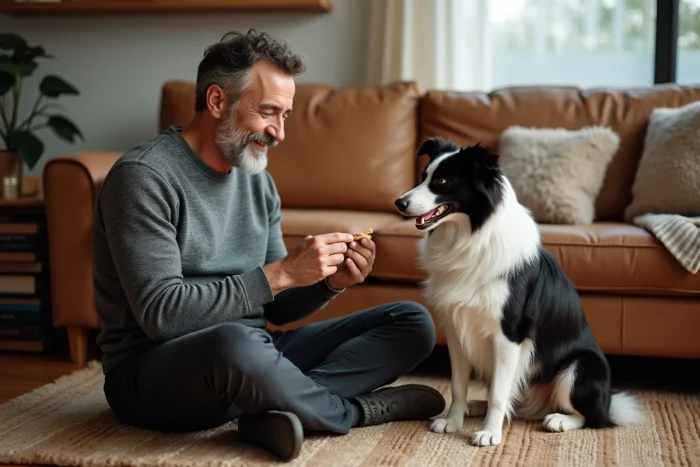
Puppy nipping: why the dental explanation is not enough
The most widespread misconception remains this: “he nips because he is teething.” This explanation is now considered too simplistic by up-to-date specialized content. Repeated nipping of hands, clothing, or furniture usually stems from incomplete learning or inappropriate management of excitement.
A puppy that has not learned to modulate the pressure of its jaw with its peers (because it was separated too early from its litter, for example) replicates this behavior with humans. Dental pain may amplify the phenomenon, but it is not the main cause.
How to respond to nipping
Withdrawing your hand and interrupting the interaction works better than yelling or pushing the puppy away. The idea is to teach him that biting ends the game. Recent guides emphasize several points:
- Immediately offer an appropriate chew object to redirect the behavior without punishing
- Never wave your fingers in front of the puppy’s mouth, as this triggers a predatory reflex
- Be consistent in your response: all household members must apply the same rule, otherwise the puppy does not understand the framework
This consistency in training aligns with a broader principle. Positive training, which remains the dominant framework, works as long as each interaction reinforces the same message.
Senior dog and behavior change: a medical signal above all
An elderly dog that becomes unclean, paces at night, no longer responds to its name, or seems disoriented is not “aging poorly.” A change in behavior in an older dog is a medical signal, not simply an educational one. Recent content clearly distinguishes learning disorders from age-related changes.
Joint pain, gradual loss of sight or hearing, cognitive dysfunction comparable to human senility: these physiological causes explain behaviors that owners sometimes attribute to “disobedience” or “temperament.”
When to consult a veterinarian for a senior dog
The reflex to consult should be triggered as soon as a behavior that has been established for years changes without apparent reason. A dog that has always been clean suddenly urinating indoors, a sociable companion that suddenly growls upon contact: these breaks in routine deserve a clinical examination before any attempts at retraining.
The veterinarian can identify chronic pain (arthritis, dental issues) or refer for a neurological assessment. Treating the medical cause often resolves the behavior without going through an educational protocol.

Dog trainer: when to call a professional
Recent guides are changing the perception of consulting a dog trainer. Long seen as a last resort reserved for “difficult cases,” professional support is now presented as a normal approach as soon as signals become ambiguous or usual responses no longer work.
An owner who doubts the origin of a behavior (fear, excitement, pain) saves time by consulting early. Field reports vary on this point: some dogs respond quickly to a simple adjustment in their living environment, while others require longer work, especially when their life history includes traumatic experiences or a lack of early socialization.
- The dog trainer helps decode signals that the owner does not perceive or misinterprets
- They adapt the method to the breed, age, and individual temperament of the dog
- They identify inconsistencies in the household’s daily life (contradictory rules, insufficient or excessive stimulation)
- In case of suspected medical issues, they refer to a veterinary behaviorist
The line between education and care can sometimes be blurry. A dog that pulls on the leash out of excitement does not require the same support as a dog that pulls out of panic. Making the right behavioral diagnosis conditions the effectiveness of the response.
Taking good care of your dog on a daily basis does not rely on a list of mechanical gestures. It is a continuous attention to what the animal expresses, sometimes very subtly. Owners who learn to observe before acting reduce most tensions and provide their companion with a living environment suited to its real needs.