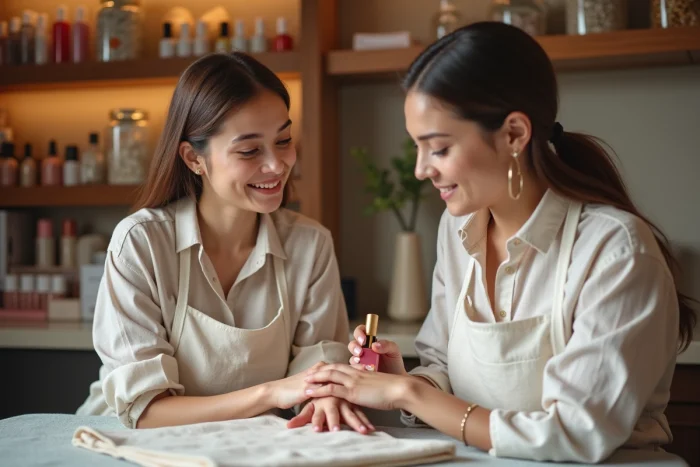
Practicing in aesthetics without holding the CAP Esthétique Cosmétique Parfumerie raises a specific question: which beauty services remain legally accessible, and which ones fall into the prohibited category? The boundary between regulated aesthetic treatments and wellness or beauty advice activities is not intuitive. It is based on texts that distinguish actions affecting the skin, hair, or nails from those related to advice, makeup, or body modeling.
Beauty services with or without aesthetic CAP: comparative table
| Service | CAP aesthetic required | Accessible without aesthetic diploma | Special condition |
|---|---|---|---|
| Hair removal (waxing, pulsed light) | Yes | No | – |
| Facial treatment (skin cleansing, extraction) | Yes | No | – |
| Manicure with cutting or pushing back cuticles | Yes | No | – |
| Makeup (without skin treatment) | No | Yes | Short training recommended |
| Nail polish application, nail art (without cuticle work) | No | Yes | Short training recommended |
| Wellness massage (body, face) | No | Yes | No mention of “aesthetic treatment” |
| Image consulting, makeovers | No | Yes | None |
| Sale and advice in cosmetics/perfume | No | Yes | None |
| Eyelash extensions, eye beauty | No | Yes | Specific training highly recommended |
| Tattooing, piercing, dermopigmentation | No | Yes | ARS authorization, mandatory hygiene training |
| UV tanning | No | Yes | Specific training, ARS declaration |
This table highlights a clear division. Any action that affects the integrity of the skin or nail falls under the CAP aesthetic. Beauty enhancement activities, advice, or non-medical modeling remain open, provided that the term “aesthetic treatment” is not used in commercial communication.
To delve deeper into what Beauté Unique offers without CAP aesthetic, categorizing actions helps clarify things before getting started.
Makeup and eye beauty without a diploma: an expanding niche
Among the services accessible without a CAP, makeup and eye beauty account for a growing share of demand. Job offers published by major brands and networks of institutes confirm this trend: positions focused on makeup, beauty advice, or commercial animation accept profiles without a CAP, provided there is demonstrated specialization.
Professional makeup does not require a CAP aesthetic, as it does not involve extraction, skin treatment, or nail manipulation. An independent makeup artist can set up as a micro-enterprise and offer event makeup, bridal makeup, or colorimetry advice.
The application of eyelash extensions follows the same logic. This highly sought-after service is not included in the CAP aesthetic framework. However, specific technical training is essential to master the bonding, choice of materials, and precautions related to the eye area.
Nail art without CAP: the regulatory nuance
The application of classic or semi-permanent nail polish and decorative nail art can be performed without an aesthetic diploma. The limit lies at the cuticle level: pushing back or cutting cuticles falls under aesthetic treatment and requires the CAP. A nail technician who limits herself to application (gel, resin, polish) without touching the skin remains within the legal framework.
Wellness massage and image consulting: activities outside the aesthetic scope
Body massage aimed at relaxation (California, hot stone, non-medical draining) does not fall under regulated aesthetics. It falls within the wellness category, provided it is not presented as a “facial treatment” or “aesthetic treatment” in commercial materials.
- Wellness massage can be offered in institutes, at home, or in companies, without a CAP, after a short training in manual techniques.
- Image consulting and makeovers do not touch the skin or nails: color analysis, clothing morphology, shopping assistance. No aesthetic diploma required.
- The sale and advice in perfumery or dermocosmetics are not subject to any aesthetic diploma requirement. Brands like Yves Rocher regularly publish beauty advisor positions open to profiles without a CAP.
Presenting a massage as an “aesthetic treatment” exposes one to sanctions, even if the technical gesture does not strictly touch the epidermis. The vocabulary used on flyers, websites, and social media has legal implications.
Tattooing, dermopigmentation, and UV tanning: outside the CAP but highly regulated
Some activities close to aesthetics fall outside the CAP scope while being subject to distinct regulations. Tattooing and piercing require mandatory training in hygiene and safety rules, certified by a certificate issued by an authorized organization. A declaration to the regional health agency (ARS) is required.
Dermopigmentation (permanent makeup for eyebrows, lips, eyeliner) follows the same regime. It does not fall under the CAP aesthetic but under tattooing practice regulations, with requirements for ink traceability and equipment sterilization.
UV tanning, on the other hand, requires specific training in operating the devices and a declaration to the ARS. These activities do not replace the CAP but impose their own regulatory constraints.
Legal status and limits for practicing without CAP aesthetic
Creating a micro-enterprise in wellness or makeup without a CAP is possible, provided one does not declare an aesthetic activity. The APE code chosen during registration must correspond to the activity actually practiced (wellness, advice, makeup), not to “beauty treatments.”
Working as an employee in an institute run by someone holding the CAP remains another option. The technical responsibility lies with the graduate, allowing a non-graduate employee to perform certain actions under supervision.
- Micro-enterprise in wellness massage: APE code 96.04Z (body maintenance), standard declaration.
- Independent makeup artist: liberal activity, no aesthetic diploma requirement.
- Employee in an institute: regulated aesthetic actions remain under the responsibility of the CAP holder present in the establishment.
Practicing aesthetic treatments without qualification exposes one to criminal sanctions. The distinction between what is permitted and what is not depends less on the place of practice than on the exact nature of the action performed and the vocabulary used to describe it.