
Your child is asking for the tablet at breakfast, the daycare announces a schedule change, and yet another message from school arrives on your phone. Parenting in 2026 is played out on multiple fronts simultaneously. Between recent regulatory changes, the growing role of digital technology in family life, and the ever-pressing issue of task sharing, the benchmarks are shifting quickly for parents.
Additional Birth Leave: What the Reform Changes for Families
Recently, each parent can benefit from an additional one to two months after maternity, paternity, child care, or adoption leave. This provision also applies to certain self-employed workers and can be taken up to nine months after the birth or arrival of the child.
In practical terms, this means more time at home with the baby during a period when routines are being established. Have you noticed how the first weeks with a newborn fly by? This extended leave allows for stabilizing family routines before returning to work.
This reform also has a cascading effect on childcare arrangements. Delays in daycare admissions related to taking this leave are compensated by the Family branch, to limit the financial impact on early childhood care facilities. Daycares are therefore not penalized if a child arrives later than expected.
At the same time, several topics related to parenting are evolving rapidly, as shown by recent articles from Conseils Parentaux that discuss these transformations as they unfold in the news.
Digital Stress for Parents: Screens, School Messages, and Information Overload
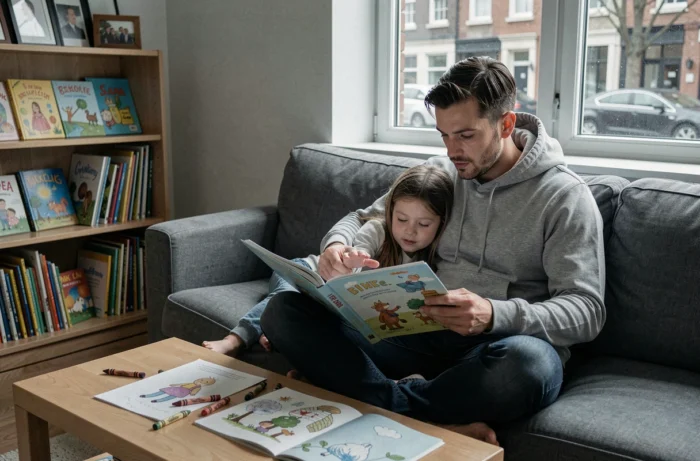
Digital technology makes access to information easier, no one disputes that. The daycare app, the online communication notebook, parent groups on social media: everything is at your fingertips. The problem arises when these tools multiply messages and fragment exchanges instead of simplifying them.
A report from the General Inspectorate of Education, Sports, and Research, dedicated to the use of digital technology in the school-family relationship (June 2025), highlights a specific phenomenon. Digital tools can transfer a portion of the coordination and monitoring work that previously fell to the school institution to parents.
The result: parents checking their notifications in the evening, on weekends, during vacations. The boundary between family life and administrative management blurs. This digital stress particularly affects households where one parent assumes daily coordination, which statistically remains the case in the majority of families.
Some Guidelines to Limit Overload
- Disable non-urgent notifications from school apps outside of office hours. A message about a cafeteria change can wait until the next morning.
- Consolidate the consultation of school or daycare-related messages into a fixed time slot, for example after dinner, rather than reading them throughout the day.
- Distingish the channels: one parent group for logistical support, another for official information. Mixing the two generates unnecessary noise.
Parental Mental Load: Why Task Sharing Remains a Blind Spot
The mental load is not limited to doing the dishes or preparing the daycare bag. It involves thinking about everything: the pediatrician appointment, shoe sizes, renewing prescriptions, the birthday gift for a friend. The one who plans carries an invisible weight that the other does not always perceive.
According to the Ifop barometer for News RSE (2025), parenting is still strongly marked by an unequal distribution of family responsibilities. Mothers still bear the majority of this domestic coordination, even in couples where both parents work full-time.
This reality has concrete consequences for women’s careers. Motherhood remains a factor in professional slowdown that current provisions do not fully compensate for.
What Works According to Recent Research
Sharing the mental load is not about “helping” the other parent. It means taking charge of a complete area without being asked. For example, fully managing the child’s medical appointments (making the appointment, attending it, passing on information to the partner) rather than waiting to be told what to do.
Change also involves recognizing this load as real work. As long as it remains invisible, it is not shared.
Screens and Children: Accompany Rather Than Prohibit

The issue of screens for children comes up in all discussions among parents. Tablets, phones, television: the time spent in front of a screen is concerning, and the temptation for a complete ban is strong.
Rather than imposing a rigid rule, child development specialists recommend accompanying usage. Watching content with the child, discussing it afterward, limiting passive screens (looped videos) in favor of active uses (thinking games, creation): these distinctions matter more than simply counting minutes.
- Before three years old, prioritizing direct interactions (talking, playing, shared reading) remains the basic recommendation in France.
- Between three and six years old, defining screen-free moments with the child (meals, trips to school) helps establish a comprehensible framework.
- After six years old, co-browsing the internet allows for jointly identifying suitable content and starting education on social media.
Families cannot bear everything alone: childcare structures, schools, and support systems form an ecosystem where every link matters.
Parenting in 2026 is not just a list of best practices. It is a daily balance between evolving regulatory constraints, intensifying digital pressure, and a slowly progressing sharing of responsibilities. Each family invents its solutions, but having reliable and up-to-date information changes the game.