How many passengers actually board a train or ship branded Orient Express? The answer varies depending on the era, the type of conveyance, and the operator. Between the historical compositions of the Paris-Istanbul, the contemporary cars of the Venice Simplon-Orient-Express, and the very recent sailing ship Orient Express Corinthian, the capacities fluctuate in a ratio of one to almost two. Comparing these capacities allows us to measure how the Orient Express brand balances exclusivity and profitability.
Passenger capacity of different Orient Express: comparative table
| Orient Express Product | Type | Maximum Capacity | Crew/Passenger Ratio |
|---|---|---|---|
| Historical Orient Express (peak) | Train | 182 travelers | Not precisely documented |
| Venice Simplon-Orient-Express (VSOE) | Luxury Train | Lower than the historical version (intentionally reduced number) | High, individual cabin service |
| La Dolce Vita Orient Express | Luxury Train (Italy) | Limited, ultra-premium positioning | High |
| Orient Express Corinthian | Cruise Sailboat | 110 passengers, 54 suites | About 170 crew members for 110 passengers |
The sharpest contrast lies between the historical version and the Corinthian sailboat. The original train could accommodate up to 182 people in sleeping cars and dining cars. The Corinthian, on the other hand, caps at 110 passengers with a crew of around 170 people, which means more than one staff member per traveler.
For detailed information on the numbers of the Orient Express according to each era and configuration, the compiled data confirms this trend of gradually reducing capacities.

Historical Orient Express vs. contemporary versions: why capacity decreases
The original train, launched in 1883 on the Paris-Istanbul line, operated with a filling logic typical of long-distance rail transport. The sleeping cars accommodated a maximum number of travelers compatible with the standards of the time, and the composition could reach about ten cars depending on the segments.
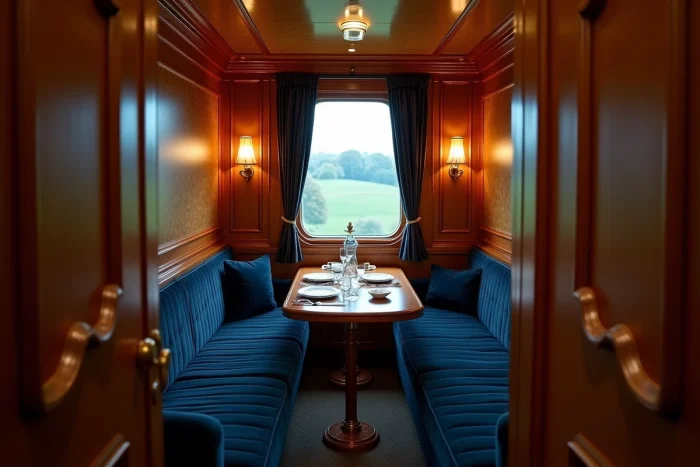
Current versions have made the opposite choice. The Venice Simplon-Orient-Express, operated by Belmond, has deliberately reduced the number of passengers on board. This reduction is not a technical constraint: the restored cars from the 1920s and 1930s could physically accommodate more travelers.
What the reduction in capacity concretely changes
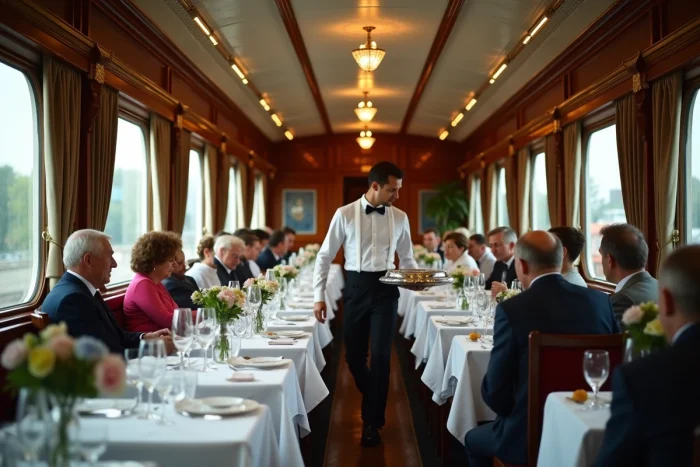
- The dining car service is done in a single seating instead of two, which extends meal times and personalizes the onboard dining experience
- The night cabins gain usable space when some double configurations are converted to single occupancy
- The staff/passenger ratio increases, allowing for a level of service close to that of a private hotel on rails
La Dolce Vita Orient Express, which inaugurates the Rome-Istanbul line, follows the same logic. The ultra-premium positioning imposes a low capacity to maintain a service level consistent with the prices charged.
Orient Express Corinthian: a sailboat that redefines the passenger-crew ratio
The extension of the Orient Express brand to maritime travel marks a break. The Corinthian, a cruise sailboat built in Saint-Nazaire, features 54 suites for a maximum of 110 passengers. The figure that stands out is that of the crew: about 170 people.
This ratio far exceeds that of traditional cruise ships, where one crew member typically manages two to three passengers. On the Corinthian, each passenger has more than one dedicated crew member, bringing the experience closer to that of a private yacht.
Rail and maritime comparison under the same brand
The capacity gap between the train and the ship reflects two distinct economic models. The train, constrained by the length of platforms and the number of cars that can be pulled, optimizes every linear meter. The sailboat, free from these constraints, has more living space per passenger.
However, both products share the same philosophy: reduce the number of passengers to increase the perceived quality of service. Both the train and the ship reject the volume increase that characterizes mass transport.
Dining car, suites, and common areas: what capacity determines
Capacity is not just a global figure. It directly conditions the organization of spaces on board.
- On the Venice Simplon-Orient-Express, the dining car serves all passengers in one rotation, which is only possible thanks to a contained capacity
- On the Corinthian, the 54 suites imply an average occupancy of two passengers per suite, leaving circulation spaces and lounges proportionally more generous than on a standard cruise ship
- The historical sleeping cars, with their compartments for two or three berths, maximized the number of travelers per square meter, at the cost of lesser comfort compared to current standards
The underlying trend has remained the same for several decades: fewer passengers on board, more space per traveler. The original cars of the Paris-Istanbul offered a few square meters per person. The suites on the Corinthian multiply this space by a significant factor.
This trajectory reflects the evolution of the Orient Express brand’s positioning. The 1883 train transported affluent clientele over long distances, competing with other modes of transport. Current products no longer sell transport but an experience where the rarity of seats is part of the promise. The number of passengers is no longer a logistical constraint: it is a commercial argument.