
The publication of marriage banns in Saint-Malo follows the rules of the Civil Code, but local practice adds requirements that the legislative framework does not foresee. Understanding these specifics before submitting a file avoids delays in the ceremony that we regularly observe.
Marriage file in Saint-Malo: the documents that really block the process
The town hall of Saint-Malo refuses to register a file and initiate the publication of banns until the documents related to the family situation are complete. Divorce judgment, death certificate of the previous spouse, dissolved PACS agreement: each document related to a previous union must be provided before any registration.
This practice, not provided for by law but now constant in Saint-Malo, means that an incomplete file on this specific point will not be put on hold. It will be outright refused.
Regarding proof of residence, the town hall requires a document less than three months old, or even one month in some cases, particularly when one of the future spouses resides in another municipality or abroad. The goal is to limit challenges from opponents regarding the jurisdiction of the civil status officer.
We recommend checking the compliance of each document related to the publication of marriage banns in Saint-Malo before presenting at the counter, as a single missing document is enough to send the couple back to square one.
Display of banns in Saint-Malo: physical board and digital register

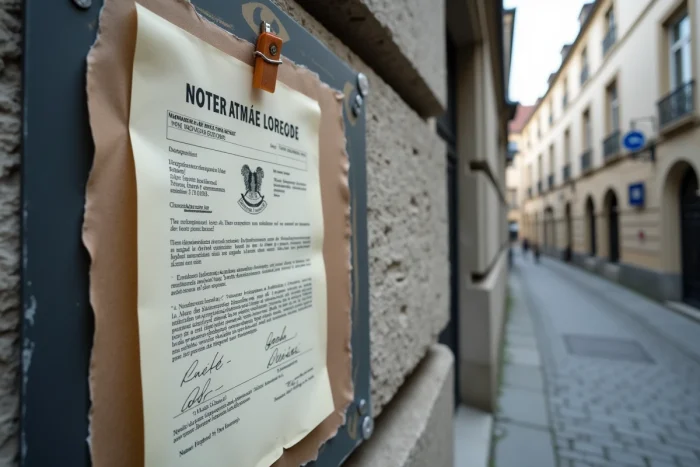
The display on the town hall board remains the visible norm, but it is no longer the only medium. Since the reform of the digitization of civil status initiated in 2021, the information is also integrated into a certified internal digital register by the ANTS. This register can be consulted upon request at the civil status service of Saint-Malo.
In practice, anyone wishing to verify if banns have been published can go to the counter or contact the service by mail. The paper board in the lobby remains accessible during town hall opening hours, but the digital register offers traceability that the board alone did not guarantee.
What the displayed notice contains
The notice mentions the identification elements of the future spouses:
- The first names, surnames, professions, residences or homes of both future spouses
- The location planned for the civil marriage celebration
- The date on which the display began, which starts the legal deadline
These mentions allow anyone aware of a legal impediment to file an opposition with the public prosecutor or directly with the civil status officer.
Deadline for publishing banns and validity: calendar constraints
The banns must remain displayed for ten days before the marriage can be celebrated. This period runs from the day after the display. If one of the future spouses resides in a different municipality, the banns are published simultaneously in both town halls, and the deadline only starts from the date of the last display.
The validity of the banns is a frequent trap. Once the publication period has expired, the marriage must be celebrated within the year that follows. Beyond that, a new publication is necessary, which implies reconstituting an up-to-date file, including birth certificates less than three months old.
Cases of marriages involving a foreign national
When a future spouse is of foreign nationality, the file goes through the public prosecutor before any publication. The prosecutor has the power to suspend and may request a supplementary investigation. This control extends the timeline by several weeks, sometimes several months.
The town hall of Saint-Malo requests in this case an even more recent residence certificate (one month) and may require a sworn translation of foreign civil status documents. We observe that couples consistently underestimate this additional delay.
Opposition to marriage after the publication of banns: who can act and how
The right of opposition is open to a limited circle of people. Ascendants (parents, grandparents) can file an opposition but must provide proof of the reasons invoked. Collaterals (siblings) and the public prosecutor must invoke a specific legal impediment:
- Existence of a previous undissolved marriage (bigamy)
- Lack of free consent from one of the future spouses
- Prohibited kinship or alliance under the Civil Code
- Territorial incompetence of the civil status officer
The opposition suspends the celebration until judicial lifting. The couple must then approach the judicial court to obtain the lifting of the opposition, a process that can take several months. In Saint-Malo, the strengthening of requirements regarding proof of residence aims precisely to reduce the risk of opposition based on territorial incompetence.
Pre-hearing of future spouses
The civil status officer may conduct a joint or separate hearing of the future spouses before publication. This hearing, provided for by the Civil Code, aims to verify the real consent and the absence of a simulated marriage.
The postponement or refusal to publish the banns following this hearing remains a prerogative of the civil status officer, who may refer to the prosecutor if he has serious doubts.
The publication of banns in Saint-Malo is not just a simple administrative display. Local requirements regarding the completeness of the file, the transition to the digital register, and enhanced checks on residence transform this step into a real filter. Anticipating each document and each deadline remains the only way to avoid a shift in the celebration date.