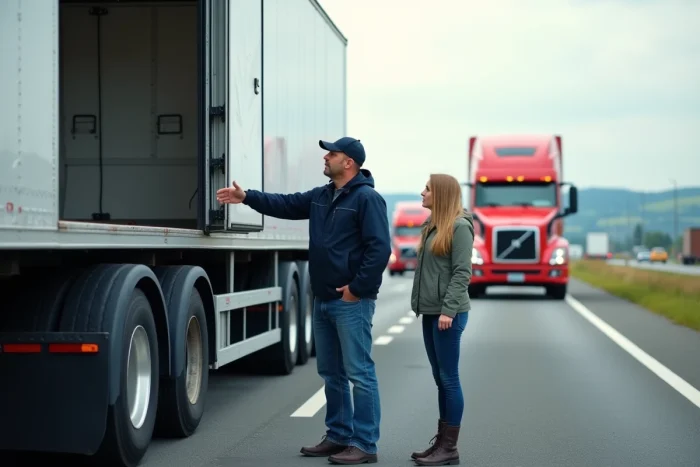
Exceeding a few centimeters on the total length of a road vehicle combination can lead to a fine, or even the immobilization of the vehicle. However, some exceptional transports also operate with dimensions well above the usual limits. Each type of semi-trailer, from standard flatbeds to container carriers, adheres to specific rules that vary according to the cargo, the route, or local regulations.
Recent changes at the European level and national adaptations further complicate matters in 2024. Carriers must juggle sometimes contradictory standards and anticipate constraints related to urban access or infrastructure.
What do the dimensions of a semi-trailer really correspond to?
In the road transport sector, the dimensions of a semi-trailer are not left to chance. Length, width, height: these parameters structure logistics across the continent. For a standard semi-trailer, expect generally 13.60 meters in length, about 2.55 meters in width (or 2.60 meters for refrigerated models), and no more than 4 meters in height. This trio of measurements is the guiding principle for all stakeholders in the sector, from the carrier to the shipper.
Loading capacity is often expressed in European pallets: 33 units measuring 1.20 x 0.80 meters, which perfectly align on a standard floor. The total capacity also depends on the maximum authorized weight (PTAC), capped at 44 tons for most five-axle configurations in France. But behind these values, variety reigns. Each type of semi-trailer, whether flatbed, tarpaulin, or refrigerated, adapts its measurements to the goods and corresponding regulations.
To navigate this, the dimensions of a semi-trailer are sometimes expressed in feet or inches depending on the origin or destination of the convoy. A 40-foot container, for example, corresponds to 12.19 meters in length and 2.44 meters in width: a different logic that applies to certain international flows. Flatbed or refrigerated trailers adhere to specific standards, always designed to adapt to roads and the handling of goods.
Mastering length, width, height, weight, and capacity is essential for traffic, safety, and transport profitability. The dimensions of trailers guide the choice of equipment, route planning, and the type of goods transported. Approaching these figures seriously means entering logistics with method and anticipation.
2024 Regulations: What You Need to Know to Operate Legally
Road freight transport is never improvised. The 2024 rules, renewed to follow European developments, strictly regulate the circulation of trucks and trailers. The maximum width allowed for a trailer remains set at 2.55 meters (2.60 meters for refrigerated ones), and the height is capped at 4 meters. These limits cover the entire French road network, regardless of the distance traveled.
The PTAC, or maximum authorized weight, is a determining criterion. Articulated combinations with five axles can reach 44 tons. Exceeding these values, even slightly, exposes one to immediate sanctions: fines, immobilization, or even license withdrawal. As for the length, it rises to 16.50 meters for the tractor and semi-trailer combination.
Key Points of the 2024 Rules
Here are the main limits to remember for 2024:
- Maximum Length: 16.50 meters (articulated combination)
- Maximum Width: 2.55 meters (2.60 m refrigerated)
- Maximum Height: 4 meters
- PTAC: 44 tons (five axles)
Adhering to these standards is imperative at every stage. This concerns both the carrier and the shipper. With each new loading, it is necessary to check dimensions, weight, and ensure stability as well as safety of the convoy. With the intensification of inspections, having reliable technical data becomes an essential routine for every professional in the sector.

Choosing the Right Semi-Trailer According to Needs and Road Transport Constraints
Selecting the right semi-trailer starts with understanding the nature of the goods to be transported and accommodating all the constraints of road transport. Requirements vary from one sector to another: temperature-controlled food products, heavy industrial equipment, bulky items, or sensitive materials. Each situation imposes a trailer format and body type that are suitable.
The question of size primarily depends on the type of loading. For standard pallets, a classic 13.60-meter trailer can hold up to 33 European pallets. However, some transports require specific formats: flatbed for machinery or atypical materials, refrigerated for perishable goods. Capacity, interior configuration, and accessibility are decisive for logistical efficiency.
Regulations impose a maximum width of 2.55 meters (2.60 meters for refrigerated ones), a height limited to 4 meters. Length and capacity must be assessed according to the density of the goods and the authorized weight. Opting for a trailer that is too large risks unnecessary costs; too small, it limits flows or complicates logistics.
To choose wisely, one must consider:
- The type of goods being transported
- Access to loading and delivery sites
- Urban constraints or specific route requirements
- The frequency of trips and the possibility of compartmentalizing according to needs (different temperatures, material incompatibilities, etc.)
A comparative table crossing different types of trailers with their uses allows for quick arbitration, leading to increasingly efficient transport organization.
At the end of the road, every centimeter counts. Choosing the right configuration means gaining peace of mind, safety, and efficiency. Mastery of dimensions, far from being a formality, shapes the daily life of modern logistics.